Algebraic, vector, polar, and exponential forms of complex numbers, including roots and De Moivre’s theorem.
Mathematics
In the number systems, algorithms, and recursion note, we introduced the categorization of numbers. This chapter will unveil the most special subset of number that we have known, which is complex number. Complex number is a powerful mathematical tool for Computer Science, especially for some machine learning algorithms and computer graphics.
In the 18th century, mathematicians were puzzled by the roots of high-degree equations. Some equations require the square root of a negative number, which is not a real number. This led to the extension from the real numbers to the complex numbers. For x2=−1, we introduce the imaginary unit i by defining i2=−1.
Definition
The equation x2=−1 is used to define imaginary number i, which gives i2=−1. The two roots are i and −i respectively.
Formally, a complex number is defined as:
Definition
A complex number is an expression of the form a+bi, where a and b are real numbers. The set of all complex numbers is denoted by C. That is, C={a+bi:a,b∈R} The letter z is often used to denote a complex number.
If a=0, then z=bi is said to be an imaginary number.
If b=0, then z=a is a real number.
The real numbers and the imaginary numbers are subsets of C
Definition
For a complex number z=a+bi, we define Re(z)=aandIm(z)=b where Re(z) is called the real part of z, and Im(z) is called the imaginary part of z.
Note: Both Re(z) and Im(z) are real numbers. That is, Re:C→R and Im:C→R.
Sometimes we need to represent or simplify a given number to complex number. refer to the following examples
Example
a Represent −5 as an imaginary number. b Simplify 2−9+4i.
Solution
a−5=5−1=i5
b2−9+4i=29−1+4i\
=2×3×i+4i\
=6i+4i\
=10i
Algebra of Complex Number
This section discusses operations on complex numbers and some of their algebraic properties. For real numbers, we have
Commutative Law of Additiona+b=b+a
Commutative Law of Multiplicationab=ba
Associative Law of Additiona+(b+c)=(a+b)+c
Associative Law of Multiplicationa(bc)=(ab)c
Distributive Law(a+b)c=ac+bc,
for any rationals a, b, and c.
These basic rules are still available for complex number.
Definition
The operations of addition and subtraction of complex numbers are given by (a+bi)±(c+di)=(a±c)+(b±d)i,
Definition
The multiplication of two complex numbers is defined by (a+bi)(c+di)=(ac−bd)+(bc+ad)i. where i2=−1.
Now consider division of complex numbers. We rationalize the denominator by multiplying by its complex conjugate, which removes the imaginary part from the denominator because i2=−1.
Definition
The division of complex numbers is given by c+dia+bi:=c2+d2ac+bd+c2+d2bc−adi(if c2+d2=0).
Verify the commutative, associative, and distributive laws for complex numbers.
Exercise
Notice that 0 and 1 retain their “identity” properties as complex numbers; that is, 0+z=z and 1⋅z=z when z is complex.
Verify that complex subtraction is the inverse of complex addition (that is, z3=z2−z1 if and only if z3+z1=z2).
Verify that complex division, as given in the text, is the inverse of complex multiplication (that is, if z2=0, then z3=z1/z2 if and only if z3z2=z1).
Exercise
Prove that if z1z2=0, then z1=0 or z2=0.
Exercise
Show that ℜ(iz)=−ℑz for every complex number z.
Hint: Prove using z=a+bi directly.
Exercise
Let k be an integer. show that
i4k=1,i4k+1=i,i4k+2=−1,i4k+3=−i and thus evalueate 3i11+6i3+i208+i−1
Proof
We know that i2=−1. Therefore, we can express powers of i in terms of powers of −1: i4ki4k+1i4k+2i4k+3=(i2)2k=(−1)2k=1,=i4k⋅i=1⋅i=i,=i4k⋅i2=1⋅(−1)=−1,=i4k+2⋅i=(−1)⋅i=−i. Now we can evaluate the given expression:
The complex numbers z1,z2 satisfy the system of equations (1−i)z1+3z2iz1+(1+2i)z2=2−3i,=1. Find z1,z2.
Hint: To find z1 and z2, we solve the system of equations and find that z1=1+i and z2=−i.
Exercise
The straightforward method of computing the product (a+bi)(c+di)=(ac−bd)+i(bc+ad) requires four (real) multiplications (and two signed additions). On most computers multiplication is far more time-consuming than addition. Devise an algorithm for computing (a+bi)(c+di) with only three multiplications (at the cost of extra additions).
Write this algorithm in pseudocode
Hint: Start with (a+b)(c+d), this is calleded “Karatsuba’s algorithm”
Solution:
$ac \gets a \cdot c$ $bd \gets b \cdot d$ $abcd \gets (a + b) \cdot (c + d)$ $real \gets ac - bd$ $imag \gets abcd - ac - bd$ $real + imag \cdot i$
Point representation of Complex Number
This section delves into the representation of Complex Number in the Cartesian coordinate, with which we are already quite familiar. In this system, we use ordered pairs like (a,b) to show the position of a given point. In the study of complex number, we can draw all complex number on a Cartesian coordinate which we call Complex Plane.
Figure pending: Complex Plane
Definition
The complex plane is a two-dimensional space where each point represents a complex number. The horizontal axis represents the real part of the number, and the vertical axis represents the imaginary part. This allows for a geometric interpretation of complex numbers.
Now that we have point representation on the complex plane, we can gauge the length of a complex number, which we call absolute value or modulus, as what we do to vectors.
Definition
The absolute value or modulus of the number z=a+bi is denoted by ∣z∣ and is given by ∣z∣:=a2+b2.
In particular, ∣0∣=0,2i=21,∣3−4i∣=9+16=5. Similarly, we can also gain the distance between two complex numbers in the plane by taking them as two points.
Definition
Let z1=a1+b1i and z2=a2+b2i. ∣z1−z2∣=∣(a1−a2)+(b1−b2)i∣=(a1−a2)2+(b1−b2)2
We can use this property to describe curves in the plane.
Example
Draw the area that satisfies ∣z−z0∣=1, where z0=2+2i.
This set consists of all points z whose distance from z0 is r.
Figure pending: Complex Number as Vector
With this, we can apply all possible operations of vectors to complex numbers, including the parallelogram law shown in Figure 1.2.
Figure pending: Parallelogram Law
Examining this figure recalls the triangle inequality. If we focus on the lower triangle of the parallelogram, the two complex numbers z1 and z2 satisfy ∣z1+z2∣≤∣z1∣+∣z2∣. This is the geometric meaning of the triangle inequality, and the vector form makes the relationship visible.
Polar Form of Complex Number
This section discusses one of the most commonly used form of complex number. We start with introducing a new coordinate syste.
The Polar Coordinate
Polar coordinates provide an alternative to Cartesian coordinates for describing the location of points in a two-dimensional plane. While Cartesian coordinates use a grid of horizontal and vertical lines to specify a point by its horizontal (x) and vertical (y) distances from an origin, polar coordinates specify a point by its distance from a reference point (called the pole, analogous to the origin) and an angle relative to a reference direction.
Figure pending: Complex Number in Polar Coordinate
A point’s location in polar coordinates is given as (r,θ), where r is the radial distance from the pole, and θ is the angular coordinate, typically measured in radians from the positive x-axis (the reference direction). Polar coordinates are particularly useful in situations where the geometry of a problem has rotational symmetry, making it more natural and simpler to work with angles and radii than with rectangular coordinates.
One of the most common applications of polar coordinates is in the field of trigonometry, complex numbers, and vector calculus, where they provide a more straightforward approach to solving problems involving circular motion, periodic functions, and fields.
Polar Expression of Complex Number
How do we obtain polar form from Cartesian form? Cartesian coordinates record horizontal and vertical displacement, while polar coordinates record a radius and an angle. Trigonometry gives
x=rcosθ,y=rsinθ,
and the radius is unambiguously
r=x2+y2=∣z∣.
However, observe that although it is certainly true that tanθ=xy, the natural conclusion θ=tan−1(xy) is invalid for points z in the second and third quadrants (since the standard interpretation of the arctangent function places its range in the first and fourth quadrants). Since an angle is fixed by its sine and cosine, θ is uniquely determined by the pair of equations cosθ=∣z∣x,sinθ=∣z∣y, And all these lead us to the polar form of a given complex number: z=x+iy=r(cosθ+isinθ)=rcisθ
Considering the circularity of radiant, we introduce the argument of complex number.
Definition
In the study of complex numbers, the argument of a complex number z, denoted as arg(z), is a fundamental concept representing the angle between the positive real axis and the line segment that joins the origin with the point z in the complex plane. Specifically, if z=x+iy, where x and y are real numbers, then arg(z) is defined as the angle θ in polar coordinates that satisfies x=rcos(θ) and y=rsin(θ), where r is the magnitude of z. The value of arg(z) is usually given in radians and, by convention, is restricted to the interval (−π,π], known as the principal value. The argument provides a complete description of the direction in which the point z lies from the origin, serving as a crucial tool in the fields of complex analysis, phasor calculus in electrical engineering, and in the representation of waves and oscillations.
Example
Find arg(1+3i) and write 1+3i in polar form.
Solutions:
Note that r=∣1+3i∣=2 and that the equations cosθ=21, sinθ=23 are satisfied by θ=3π. Hence arg(1+3i)=3π+2kπ,k=0,±1,±2,… [in particular, Arg(1+3i)=3π]. The polar form of 1+3i is 2(cos3π+isin3π)=2cis3π.
More properties of polar form complex number could be derived with properties of trigonometric identities. Now suppose we have z1=r1(cosθ1+isinθ1),z2=r2(cosθ2+isinθ2) then we have z1z2=r1r2[(cosθ1cosθ2−sinθ1sinθ2)+i(sinθ1cosθ2+cosθ1sinθ2)] which follows that z1z2=r1r2[cos(θ1+θ2)+isin(θ1+θ2)]
Remark
The compound angle formula is applied in the proof, which should already been covered in high school syllabus. You may refer to this link for further information. A concise proof is provided below.
Proof of the composite-angle formulas:Proof of the Composite Angle Formulas. To prove the sine of the sum of two angles α and β, we can use the unit circle and the definition of sine and cosine.
Consider a unit circle where point A corresponds to angle α, and point B corresponds to angle α+β. Point A has coordinates (cos(α),sin(α)), and point B has coordinates (cos(α+β),sin(α+β)).
By rotating point A by angle β, we can form a right triangle where the new point, C, has coordinates (cos(α)cos(β)−sin(α)sin(β),sin(α)cos(β)+cos(α)sin(β)).
The coordinates of point C represent the cosine and sine of the sum of angles α and β due to the rotation. Therefore, we have:
Similarly, by considering the rotation in the opposite direction (subtracting angle β from α), we can derive the formulas for the sine and cosine of the difference of two angles:
Thus, we have proven the composite angle formulas for sine and cosine.
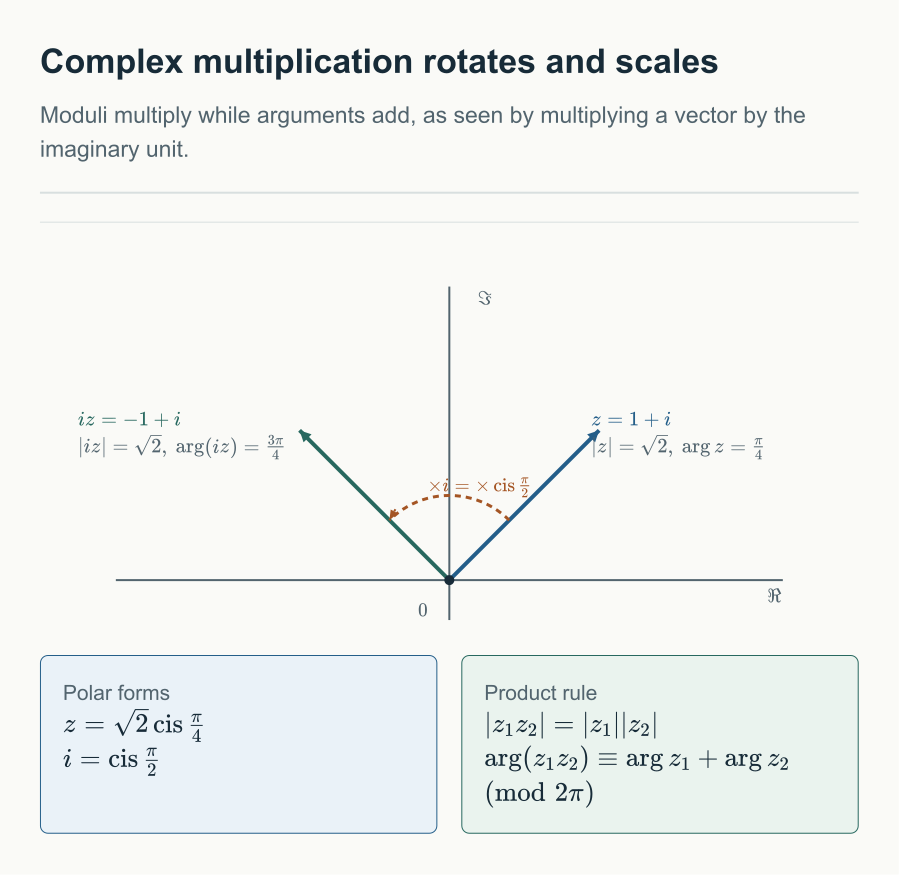
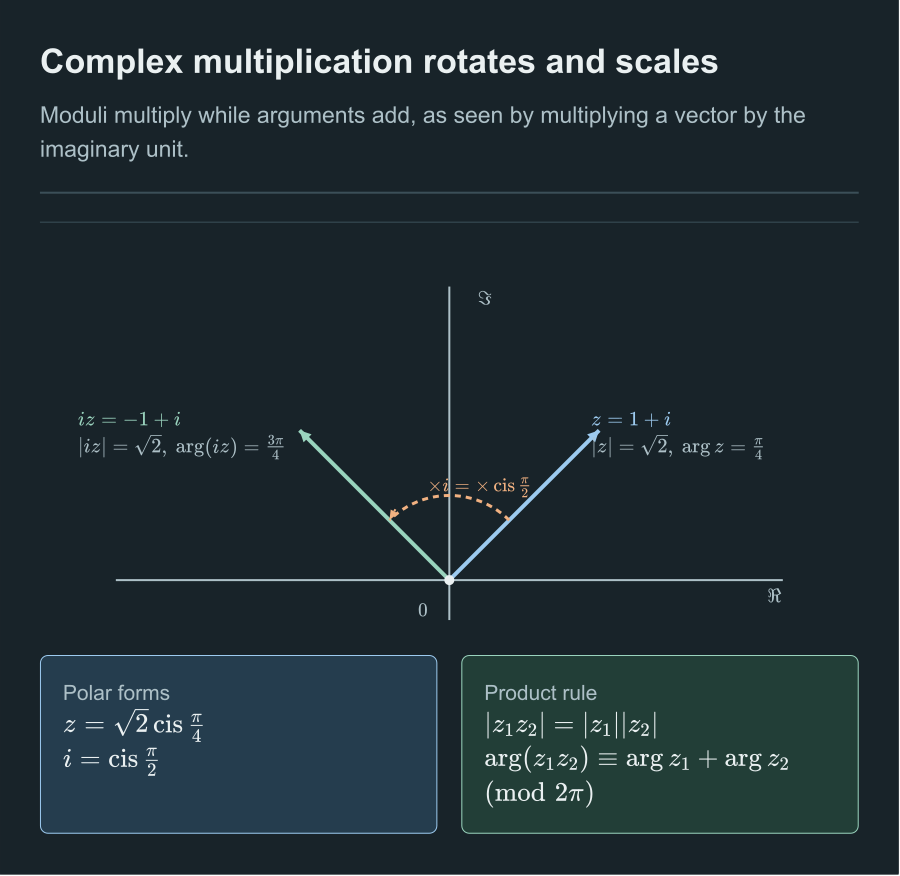
The abbreviated version of Eq. polarprod reads as follows: z1z2=(r1cisθ1)(r2cisθ2)=(r1r2)cis(θ1+θ2) and we see that
The modulus of the product is the product of the moduli:∣z1z2∣=∣z1∣∣z2∣(=r1r2);
The argument of the product is the sum of the arguments:argz1z2=argz1+argz2(=θ1+θ2). As division is the inverse of multiplication, we can get the following statements by similar method: z2z1=r2r1[cos(θ1−θ2)+isin(θ1−θ2)]=r2r1cis(θ1−θ2)arg(z2z1)=argz1−argz2z2z1=∣z2∣∣z1∣
Example
Write the quotient (3−i)(1+i) in polar form.
Proof
The polar forms for 1+i and 3−i are 1+i=∣1+i∣cis(arg(1+i))=2cis(4π),3−i=2cis(−6π). Hence, from Eq. 5.8, we have 3−i1+i=22cis(4π−(−6π))=22cis(125π).
Exercises
Exercise
Find the following:
−2−i1+2i
∣(1+i)(2−3i)(4i−3)∣
(1−i)2i(2+i)3
(π−i)100(π+i)100
Exercise
Draw the following vectors:
7cis(43π)
4cis(−6π)
cis(43π)
3cis(427π)
Exercise
Find the argument of each of the following complex numbers and write each in polar form:
−21
−3+3i
−πi
−23−2i
(1−i)(−3+i)
(3−i)2
2+2i−1+3i
3+i−7(1+i)
Exercise
Show geometrically that the nonzero complex numbers z1 and z2 satisfy ∣z1+z2∣=∣z1∣+∣z2∣ if and only if they have the same argument.
Proof
If z1 and z2 have the same argument, it follows that:
We see here if z1=r1(cosθ+isinθ), z2=r2(cosθ+isinθ), then ∣z1+z2∣=∣r1(cosθ+isinθ)+r2(cosθ+isinθ)∣=∣(r1+r2)(cosθ+isinθ)∣=r1+r2=∣z1∣+∣z2∣
Exercise
Given the vector z, interpret geometrically the vector (cosϕ+isinϕ)z.
Geometrically this: rcis(θ+ϕ) means a vector that its length r and argument is θ+ϕ, we can get it by rotating vector z about origin through an angle ϕ in the counterclockwise direction.
Exercise
Show that ∣z1z2z3∣=∣z1∣∣z2∣∣z3∣ and thus prove ∣∏i=1nzi∣=∏i=1n∣zi∣
Remark:∏ is called pi (upper case) notation. Take it as the sigma notation for multiplication.
Proof
Consider the complex numbers z1=r1(cosθ1+isinθ1), z2=r2(cosθ2+isinθ2), and z3=r3(cosθ3+isinθ3), where r1,r2, and r3 are the moduli of z1,z2, and z3 respectively, and θ1,θ2, and θ3 are the arguments. The product z1z2z3 is then given by: z1z2z3=r1r2r3(cos(θ1+θ2+θ3)+isin(θ1+θ2+θ3))
The modulus of this product is: ∣z1z2z3∣=∣r1r2r3(cos(θ1+θ2+θ3)+isin(θ1+θ2+θ3))∣=r1r2r3
Since the moduli of z1,z2, and z3 are r1,r2, and r3 respectively, it follows that: ∣z1z2z3∣=∣z1∣∣z2∣∣z3∣
Now, extend this property to a product of n complex numbers: ∏i=1nzi=∏i=1nri(cosθi+isinθi)
Taking the modulus of both sides: ∣∏i=1nzi∣=∣∏i=1nri(cosθi+isinθi)∣=∏i=1nri
Thus: ∏i=1n∣zi∣=∏i=1n∣zi∣
as required.
MI is also a option:
Base case (n=1): For a single complex number z1, the statement is trivially true since ∣z1∣=∣z1∣.
Inductive step: Assume the statement holds for n=k, i.e., ∏i=1k∣zi∣=∏i=1k∣zi∣ Now consider n=k+1 complex numbers. By the induction hypothesis and the property that the modulus of a product is equal to the product of the moduli for any two complex numbers a and b, namely ∣ab∣=∣a∣∣b∣, we have: ∏i=1k+1∣zi∣=∣zk+1∣∏i=1k∣zi∣=∣zk+1∣∏i=1k∣zi∣=∏i=1k+1∣zi∣ Thus, by mathematical induction, the statement is proved for all n∈N.
Recall that the dot (scalar) product of two planar vectors v1=(x1,y1) and v2=(x2,y2) is given by: v1⋅v2=x1x2+y1y2.Show that the dot product of the vectors represented by the complex numbers z1 and z2 is given byz1⋅z2=Re(z1z2).
Proof
Let z1,z2∈C.
We can represent z1,z2 as vectors as follows: z1=(x1,y1)=x1+y1j,z2=(x2,y2)=x2+y2jz1⋅z2=(x1+y1j)⋅(x2+y2j)=x1x2+y1y2+x1y2(j⋅j)+x2y1(i⋅j)=x1x2+y1y2+0+0(∵i2=j2=−1,i⋅j=0)∴z1⋅z2=x1x2+y1y2(1)
Now we’ll find: z1z2=(x1−y1j)(x2+y2j)=x1x2+y1y2+x1y2(−j)−x2y1j∴Re(z1z2)=x1x2+y1y2(2)
From (1) and (2) we get: z1⋅z2=Re(z1z2)=x1x2+y1y2
Exercise
We have proven the Generalized Triangle Inequality in last chapter that: ∣∑k=1nzk∣≤∑k=1n∣zk∣ For complex numberz1, z2, and z3, prove that: m1+m2+m3m1z1+m2z2+m3z3≤1
Proof
We’ll take at first: m1+m2+m3m1z1+m2z2+m3z3=∣m1+m2+m3∣∣m1z1+m2z2+m3z3∣
Now we’ll find: ∣m1z1+m2z2+m3z3∣≤∣m1z1∣+∣m2z2∣+∣m3z3∣(Triangle inequality)=m1∣z1∣+m2∣z2∣+m3∣z3∣≤m1+m2+m3(since m1,m2,m3>0 and ∣z1∣,∣z2∣,∣z3∣≤1)=∣m1+m2+m3∣
The other form for complex number is its exponential form with base e. Euler’s formula relate the exponential expression to the polar expression. However, the proof of Euler’s formula require further knowledge of calculus, such as Taylor series. You may access this link for a proof without calculus. You can also just skip the proof for now, since it does not affect the problem-solving in this chapter.
Definition
eiy=cosy+isiny
You can relate this formula to the polar form very easily, since the right-hand side is equivalent tocisy, which means y is exactly the principal argument of the complex number, θ.
Euler’s Formula enables us to write the polar form of a complex number as z=rcisθ=r(cosθ+isinθ)=reiθ. Thus, we can (and do) drop the awkward “cis” artifice and use, as the standard polar representation, z=reiθ=∣z∣eargz. In particular, notice the following identities: ei0=e2πi=e−2πi=e4πi=e−4πi=⋯=1,e(π/2)i=i,e(−π/2)i=−i,eπi=−1.
Observe also that eiargz=1 and that Euler’s equation leads to the following representations of the customary trigonometric functions: cosθ=Reeiθ=2eiθ+e−iθ,sinθ=Imeiθ=2ieiθ−e−iθ.
Proof
We start with Euler’s formula which states that for any real number θ, eiθ=cos(θ)+isin(θ). The complex conjugate of eiθ is e−iθ, which gives us e−iθ=cos(−θ)+isin(−θ)=cos(θ)−isin(θ), since cosine is an even function, cos(−θ)=cos(θ), and sine is an odd function, sin(−θ)=−sin(θ).
To derive the expression for the cosine function, we take the sum of eiθ and e−iθ, and divide by 2: cos(θ)=2eiθ+e−iθ. This is because the imaginary parts isin(θ) and −isin(θ) cancel each other out, leaving the sum of cos(θ)+cos(θ), which is then divided by 2.
To derive the expression for the sine function, we take the difference of eiθ and e−iθ, and divide by 2i: sin(θ)=2ieiθ−e−iθ. Here, the real parts cos(θ)−cos(θ) cancel out, leaving the difference of isin(θ)−(−isin(θ)) which is 2isin(θ), and then dividing by 2i yields sin(θ).
This completes the derivation of the exponential forms of the sine and cosine functions.
The rules derived in definition polarform for multiplying and dividing complex numbers in polar form now find very natural expressions: z1z2=(r1eiθ1)(r2eiθ2)=(r1r2)ei(θ1+θ2),z2z1=r2eiθ2r1eiθ1=(r2r1)ei(θ1−θ2), and complex conjugation of z=reiθ is accomplished by changing the sign of i in the exponent: zˉ=re−iθ.
Example
Compute (a) 3−i1+i and (b) (1+i)24.
Solution:
(a) This quotient was evaluated using the cis operator in Example 1.11 of Sec. 1.3; using the exponential the calculations take the form 1+i=2cis(4π)=2eiπ/4,3−i=2cis(−6π)=2e−iπ/6, and, therefore, 3−i1+i=2e−iπ/62eiπ/4=22ei5π/12.
(b) The exponential forms become (1+i)24=(2eiπ/4)24=(224)ei24π/4=212ei6π=212.
De Moivre’s Theorem
De Moivre’s Theorem is a fundamental result in complex analysis that connects complex numbers and trigonometry. Named after the French mathematician Abraham de Moivre, the theorem provides a formula for raising complex numbers to any power using polar coordinates.
Given a complex number expressed in polar form as z=r(cosθ+isinθ), where r is the modulus and θ is the argument of the complex number, De Moivre’s Theorem states that:
Theorem
zn=rn(cosnθ+isinnθ) or in exponential form: (eiθ)n=(n times )eiθeiθ⋯eiθ=eiθ+iθ+⋯+iθ=einθ
for any integer n. This elegant relationship not only simplifies the computation of powers of complex numbers but also lays the foundation for finding roots of complex numbers.
The theorem is particularly useful because it transforms a potentially difficult multiplication problem into a much simpler form by taking advantage of the properties of exponential functions and Euler’s formula, which expresses complex exponentiation in terms of sine and cosine:
eiθ=cosθ+isinθ
Through this lens, De Moivre’s Theorem is often used to derive results in trigonometry, such as trigonometric identities for sine and cosine of multiple angles, and it plays a crucial role in the field of complex analysis. This theorem could be proven by simple MI.
Proof
We proceed by induction on n.
Base case: For n=1, the statement holds trivially: (cos(θ)+isin(θ))1=cos(θ)+isin(θ).
Inductive step: Assume that the theorem holds for some integer k, that is (cos(θ)+isin(θ))k=cos(kθ)+isin(kθ). Now consider the case for k+1: (cos(θ)+isin(θ))k+1=(cos(θ)+isin(θ))k(cos(θ)+isin(θ))=(cos(kθ)+isin(kθ))(cos(θ)+isin(θ))(by inductive hypothesis)=cos(kθ)cos(θ)−sin(kθ)sin(θ)+i(sin(kθ)cos(θ)+cos(kθ)sin(θ))=cos((k+1)θ)+isin((k+1)θ)(using angle addition formulas). Thus, the theorem holds for k+1.
By induction, the theorem is true for all integers n.
Exercises
Exercise
Write each of the given numbers in Cartesian form.
e−iπ/4
e−1+iπ/2e1+i3π
eei
2ie3i−e−3i
2e3+iπ/6
ez, where z=4eiπ/3
Exercise
Write each of the given numbers in exponential form.
31−i
−8(1+3i)
(1+i)6
cos(92π)+isin(92π)
−3+i2+2i
3ei2i
Exercise
Consider a complex number sequence {xn}, where xn=(1+i)n and n is a non-negative integer. Calculate the sum of the first N terms of the sequence, SN=∑n=0N−1xn.
Hint: Utilize the properties of powers of complex numbers and summation formulas to solve this problem. Consider converting 1+i into its exponential form to simplify the calculation. Solution:
Let xn=(1+i)n, then the sum of the first N terms of the sequence SN is:
SN=∑n=0N−1xn
Using the exponential form of 1+i, which is 2ei4π, we have:
SN=∑n=0N−1(2ei4π)n
The sum of a geometric series with the common ratio r is:
SN=1−r1−rN
Substituting r=2ei4π into the formula gives us:
SN=1−2ei4π1−(2ei4π)N
This can be further simplified depending on the value of N.
Exercise
Show that for z=ex+iy, the modulus ∣z∣ is ex and the argument arg(z) is y+2kπ for k=0,±1,±2,….
Solution: For z=x+iy,
ez=ex(cos(y)+isin(y))=excos(y)+exisin(y)
Let this be a complex number that is, z1=ez=excos(y)+exisin(y). Now, modulus of z1,
Since tan(y) is a periodic function with period 2π,
arg(z1)=arg(ex+iy)=y+2kπ,∀k∈Z
Exercise
Show that, for all z,
ez+πi=−ez
ezˉ=ez
Solution:
ez+πi=−ez
We know for z=x+iy, ez=ex(cosy+isiny).
Consider the left-hand side for z=x+iy, ez+πi=ex+i(y+π)=ex(cos(y+π)+isin(y+π))=ex(−cosy−isiny)=−ex(cosy+isiny)=−ez
ezˉ=ez We know, for z=x+iy, ez=ex(cosy+isiny). Therefore, ezˉ=ex(cosy−isiny)(1)
For zˉ=x−iy, ezˉ=ex−iy=ex(cos(−y)+isin(−y))=ex(cosy−isiny)(2)
From equations (1) and (2), we can say that, ezˉ=ez
Exercise
Show that ez=ez+2πi for all z. (The exponential function is periodic with period 2πi.)
textbfSolution:
We have to prove that ez=ez+2πi for all z.
Start with the right-hand side. Consider for z=x+iy, ez+2πi=ex+iy+2πi=ex+i(y+2π)
We know that ez=ex+iy=ex(cosy+isiny)
Applying this to the above, ex+i(y+2π)=ex(cos(y+2π)+isin(y+2π))
We know that sin and cos are both periodic functions with period being 2π. This means that cos(y+2π)sin(y+2π)=cosy=siny
Thus, ez+2πi=ex(cosy+isiny)=ex+iy=ez
Therefore, ez is a periodic function with period 2πi.
Finding Complex Roots
In this section, we will not be too obsessed with the form of complex number, but focus on the practical reason why we need complex number: finding roots. Because of this, this section could be a little tedious, as it is more like middle school algebra, nothing really new but algebra techniques, yet they are important for further mathematical learning.
Solving Quadratic Equations Over the Complex Numbers
In the middle school, we have been introduced many ways to find Solutions for quadratic equations, like factorization or using the determinant δ.
Let’s make q quick recap on the determinant of quadratic equation. A quadratic equation is a second-order polynomial equation in a single variable x with the form ax2+bx+c=0, where a, b, and c are constants, and a=0. The expression under the square root, b2−4ac, is known as the discriminant. The discriminant can tell us about the nature of the roots:
If the discriminant is positive, there are two distinct real roots.
If the discriminant is zero, there is one real root (also known as a repeated or double root).
If the discriminant is negative, there are no real roots, but two complex roots.
The solutions to the quadratic equation are known as the roots of the equation, which can be found using the quadratic formula:
Theorem
x=2a−b±b2−4ac
Proof
Starting with the standard form of the quadratic equation: ax2+bx+c=0
Divide through by a (where a=0) to normalize the quadratic term: x2+abx+ac=0
Subtract ac from both sides: x2+abx=−ac
To complete the square, add (2ab)2 to both sides: x2+abx+(2ab)2=(2ab)2−ac
Write the left side as a square and simplify the right side: (x+2ab)2=4a2b2−4ac
Take the square root of both sides: x+2ab=±4a2b2−4ac
Solve for x: x=−2ab±2ab2−4ac
Combining the terms gives us the quadratic formula: x=2a−b±b2−4ac This concludes the introduction and proof of the determinant and roots of quadratic equations.
Also, since i2=−1, we can rewrite a sum of two squares as a difference of two squares:
For more complex equations, we tend to use the root formula.
Example
Solve each of the following equations for z:
z2+z+3=0
2z2−z+1=0
z2=2z−5
Solution:z2+z+3Hence z2+z+3z=(z−(−21−211i))(z−(−21+211i))=0 has solutions=−21−211iandz=−21+211i
2z2−z+1Hence 2z2−z+1z=2(z−(−41−47i))(z−(−41+47i))=0 has solutions=41−47iandz=41+47iz2−2z+5Now apply the quadratic formula:zThe solutions are 1+2i=0=22±−16=22±4i=1±2i and 1−2i.
Solving Polynomial Equations on Complex Number
Now let’s try to solve some more tricky and general problems. Quadratic equation is actually a special case of polynomial equations, which is defined as:
Definition
a polynomial of degree n is an expression of the form P(z)=anzn+an−1zn−1+⋯+a1z+a0 where the coefficients ai are complex numbers and an=0.
When we divide the polynomial P(z) by the polynomial D(z) we obtain two polynomials, Q(z) the quotient and R(z) the remainder, such that P(z)=D(z)Q(z)+R(z) and either R(z)=0 or R(z) has degree less than D(z).
If R(z)=0, then D(z) is a factor of P(z). Here we introduce two important theorems about polynomial.
Theorem
Let α∈C. When a polynomial P(z) is divided by z−α, the remainder is P(α).
Proof
Consider the polynomial division of P(z) by z−α, expressed as P(z)=(z−α)Q(z)+R where Q(z) is the quotient and R is the remainder. Since R is a polynomial with degree less than that of z−α, R is a constant. Evaluating P(z) at z=α gives: P(α)=(α−α)Q(α)+R=R. Therefore, the remainder of the division of P(z) by z−α is R=P(α).
Theorem
Let α∈C. Then z−α is a factor of a polynomial P(z) if and only if P(α)=0.
Proof
Suppose that z−α is a factor of P(z). Then P(z) can be written as P(z)=(z−α)Q(z) for some polynomial Q(z). Evaluating at z=α yields: P(α)=(α−α)Q(α)=0. This shows that if z−α is a factor of P(z), then P(α)=0.
Conversely, if P(α)=0, by the Remainder Theorem we have P(z)=(z−α)Q(z)+P(α)=(z−α)Q(z) as P(α)=0. Therefore, P(z) is divisible by z−α, and z−α is a factor of P(z).
We start with a simple example.
Example
Factorize P(z)=z3+z2+4.
Solution: Use the factor theorem to find the first factor:
P(−1)=−1+1+4=0P(−2)=−8+4+4=0
Therefore z+2 is a factor. We obtain P(z)=(z+2)(z2−z+2) by division.
It is noticeable that two of the roots in the example are conjugate to each other. Let’s recall that, in exercise conjugate root, we have proven this as “Conjugate Root Theorem”.
Theorem
Let P(z) be a polynomial with real coefficients. If a+bi is a solution of the equation P(z)=0, with a and b real numbers, then the complex conjugate a−bi is also a solution.
With this theorem, we can solve equations of higher order more quickly.
Example
Let P(z)=z3−3z2+5z−3.
Use the factor theorem to show that z−1+2i is a factor of P(z).
Find the other linear factors of P(z).
Solution:a. To show that z−(1−2i) is a factor, we must check that P(1−2i)=0. We have
P(1−2i)=(1−2i)3−3(1−2i)2+5(1−2i)−3=0
Therefore z−(1−2i) is a factor of P(z).
b. Since the coefficients of P(z) are real, the complex linear factors occur in conjugate pairs, so z−(1+2i) is also a factor.
To find the third linear factor, first multiply the two complex factors together:
For this kind of simple expression that we can find some solutions easily, we can also use a more simplified method. All you need to do is to apply long division to the original expression and the product of known factors. Here we know that z=±1 are two solutions, and (z+1)⋅(z−1)=z2−1. Thus, we apply long division. \renewcommand\arraystretch{1.2}
\begin{array}{r|l}
\multicolumn{2}{r}{z^4 + z^2 + 1} \\
\cline{2-2}
z^2 - 1 & z^6 - 0z^5 - 0z^4 - 0z^3 + 0z^2 - 0z - 1 \\
\multicolumn{2}{r}{- (z^6 - 0z^4)} \\
\cline{2-2}
\multicolumn{2}{r}{0z^5 + z^4} \\
\multicolumn{2}{r}{- (0z^5 + z^4 - z^2)} \\
\cline{2-2}
\multicolumn{2}{r}{0z^4 + z^2} \\
\multicolumn{2}{r}{- (0z^4 + z^2 - 1)} \\
\cline{2-2}
\multicolumn{2}{r}{1} \\
\end{array}
The expression z4+z2+1 can be factored over the complex numbers. It can be written as a quadratic in terms of z2:
u2+u+1=0,whereu=z2
Using the quadratic formula to solve for u:
u=2−1±−3=2−1±i3
Thus, the roots for z2 are:
z2=2−1+i3,z2=2−1−i3
The factorization of the original polynomial is therefore:
z4+z2+1=(z2+21−2i3)(z2+21+2i3)
This can be further factored to obtain the linear factors in terms of z:
So far, we have solved problems on polynomials of different orders. It seems so far that a n order polynomial has exactly n solutions. Is this a generalized law? This is actually a corollary under Fundamental Theorem of Algebra.
Theorem
Every polynomial P(z)=anzn+an−1zn−1+…+a1z+a0 of degree n, where n≥1 and the coefficients ai are complex numbers, has at least one linear factor in the complex number system.
Given any polynomial P(z) of degree n≥1, the theorem tells us that we can factorize P(z) as P(z)=(z−α1)Q(z) for some α1∈C and some polynomial Q(z) of degree n−1. By applying the fundamental theorem of algebra repeatedly, it can be shown that:
Corollary
A polynomial of degree n can be factorized into n linear factors in C: i.e.,P(z)=an(z−α1)(z−α2)…(z−αn), where α1,α2,…,αn∈C
A polynomial equation can be solved by first rearranging it into the form P(z)=0, where P(z) is a polynomial, and then factorizing P(z) and extracting a solution from each factor. If P(z)=(z−α1)(z−α2)…(z−αn), then the solutions of P(z)=0 are α1,α2,…,αn. The solutions of the equation P(z)=0 are also referred to as the zeroes or the roots of the polynomial P(z).
Example
Solve each of the following equations over C:
P(z)=z2+64=0
P(z)=z3+3z2+7z+5=0
P(z)=z3−iz2−4z+4i=0
Solution:
(a)
(z+8i)(z−8i)=0
(b)
=(z+1)(z+21−27i)(z+21+27i)
(c) (z−i)(z−2)(z+2)=0
Solving Equation with De Moivre’s Theorem
With the help of complex number, we have “conquered” polynomial equations. Now we will focus on solving equations with de Moivre’s theorem.
Equations of the form zn=a, where a∈C, are often solved by using De Moivre’s theorem.
Write both z and a in polar form, as z=rcisθ and a=qcisφ.
Then zn=a becomes (rcisθ)n=qcisφ∴rncis(nθ)=qcisφ(using De Moivre’s theorem) Compare modulus and argument: rn=qandcis(nθ)=cisφr=nqnθ=φ+2kπwherek∈Zθ=n1(φ+2kπ)wherek∈Z This will provide all the solutions of the equation.
Example
Solve z3=1.
Solution Let z=rcisθ. Then (rcisθ)3=1cis0∴r3cis(3θ)=1cis0∴r3=1and3θ=0+2kπwherek∈Z∴r=1andθ=32kπwherek∈Z Hence the solutions are of the form z=cis(32kπ), where k∈Z.
We start finding solutions.
For k=0: z=cis0=1
For k=1: z=cis(32π)
For k=2: z=cis(34π)=cis(−32π)
For k=3: z=cis(2π)=1
The solutions begin to repeat.
The three solutions are 1, cis(32π), and cis(−32π). We can plot these solutions on the complex plane.
Figure pending: Solutions for z3 = 1
The solutions are shown to lie on the unit circle at intervals of 32π around the circle. We find that the number of roots, of course, follows that the number of roots equal to the order of expression.
To generalize, we can see that there are exactly m distinct mth roots of unity, denoted by 11/m=ei2kπ/m=cosm2kπ+isinm2kπ(k=0,1,2,…,m−1).
Theorem
For n∈N and a∈C, the solutions of the equation zn=a are called the nth roots of a.
The solutions of zn=a lie on a circle with center the origin and radius ∣a∣1/n.
There are n solutions and they are equally spaced around the circle at intervals of n2π. This observation can be used to find all solutions if one is known.
More generally, consider any natural number n≥2. Using De Moivre’s theorem, we can show that the nth roots of unity are 1,,cis(n2π),,cis(n4π),,…,,cis(n2(n−1)π) So the nth roots of unity form a geometric sequence with common ratio ω=cis(n2π). We can list the terms of this sequence as 1,ω,ω2,…,ωn−1. The sum of the terms is 1+ω+ω2+…+ωn−1=ω−1ωn−1 since ωn=1.
Proof
The nth roots of unity are solutions to the equation zn=1. By expressing 1 in polar form as 1cis0, and applying De Moivre’s theorem, (rcisθ)n=rncis(nθ), we find that for zn=1, we must have z=cis(n2kπ), where k is an integer from 0 to n−1.
These solutions can be written as a sequence where each term after the first is obtained by multiplying the previous term by cis(n2π), making it a geometric sequence with a common ratio of ω=cis(n2π).
The sum of a geometric sequence with n terms and a common ratio r=1 is given by Sn=a11−r1−rn. For our sequence, a1=1 and r=ω, so the sum is Sn=1−ω1−ωn. Since ωn=cis(2π)=1, the numerator becomes 1−1=0, hence the sum Sn is zero.
To obtain the mth roots of an arbitrary (nonzero) complex number z=reiθ, we generalize the idea and, reasoning similarly, conclude that the m distinct mth roots of z are given by z1/m=m∣z∣ei(θ+2kπ)/m(k=0,1,2,…,m−1)
Equivalently, we can form these roots by taking any single one such as given in (3) and multiplying by the mth roots of unity.
Example
Find all the cube roots of 2+i2.
Solution: The polar form for 2+i2 is 2+i2=2eiπ/4. Putting ∣z∣=2, θ=π/4, and m=3 into Eq. mthroot, we obtain (2+i2)1/3=32ei(π/12+2kπ/3)(k=0,1,2). Therefore, the three cube roots of 2+i2 are 32(cosπ/12+isinπ/12), 32(cos3π/4+isin3π/4), and 32(cos17π/12+isin17π/12).
Exercises
Exercise
Let P(z)=2z3+9z2+14z+5.
Use the factor theorem to show that z+2−i is a linear factor of P(z).
Write down another complex linear factor of P(z).
Hence find all the linear factors of P(z) over C.
Solution
a. By the factor theorem, if z+2−i is a factor of P(z), then P(−2+i)=0. Calculating this we get: P(−2+i)=2(−2+i)3+9(−2+i)2+14(−2+i)+5=2(−8−12i+6i2)+9(4−8i+2i2)+14(−2+i)+5=2(−8−12i−6)+9(4−8i−2)+(−28+14i)+5=−28−24i−12+36−72i−18−28+14i+5=0. Thus, z+2−i is a linear factor of P(z).
b. By the conjugate root theorem, if z+2−i is a root, then its conjugate z+2+i is also a root.
c. Having found two complex roots, we can divide P(z) by the product of the corresponding factors to find the remaining factor. Let’s perform the division (this is a mock example; the actual division should be computed):
P(z)=(z+2−i)(z+2+i)(z−α)
After performing the division, we find that the remaining factor is z−21. Thus, the linear factors of P(z) are:
P(z)=(z+2−i)(z+2+i)(z−21)
Exercise
For a cubic polynomial P(x) with real coefficients, it is given that P(2+i)=0, P(1)=0 and P(0)=10. Express P(x) in the form P(x)=ax3+bx2+cx+d and solve the equation P(x)=0.
solution:
Given that P(x) is a cubic polynomial with real coefficients and P(2+i)=0, we know that its conjugate P(2−i)=0 as well, due to the complex conjugate root theorem. Moreover, since P(1)=0, we can write P(x) as:
Since P(2+i)=0, by conjugate root theorem, p(2−i)=0, and we also have p(1)=0. The order of this expression is 3, by the fundamental algebra theorem, we have found all solutions.
Exercise
If z=1+i is a zero of the polynomial z3+az2+bz+10−6i, find the constants a and b, given that they are real.
solution:
Since z=1+i is a zero, by the Complex Conjugate Root Theorem, z=1−i is also a zero. Substituting z=1+i into the polynomial gives:
For the polynomial to be zero, both the real and imaginary parts must be zero. Therefore, we have two equations:
−2+b+102a−6=0(Real part)=0(Imaginary part)
Solving these equations gives us a and b:
ba=−8=3
Thus, the constants are a=3 and b=−8.
Exercise
Let n be a positive integer. Prove that arg(zn)=nArg(z)+2kπ,k=0,±1,±2,…,forz=0
Proof
Let’s take z∈C. We can write z in its polar form as z=∣z∣(cosθ+isinθ)
By definition of argz and Argz we have: arg(z)=θ+2kπ,k∈Z,θ∈[−π,π] and Arg(z)=arg−(z)=θ,θ∈[−π,π].
Now if we take the polar form of zn, where n∈N,n=0, we have zn=∣z∣n(cos(nθ)+isin(nθ))
⇒arg(zn)=nθ+2kπ=nArg(z)+2kπ,k∈Z
This concludes the proof.
Exercise
Find all the values of the following.
(−16)1/4
11/5
i1/4
(1−3i)1/3
(i−1)1/2
(1+i2i)1/6
Exercise
Find all four roots of the equation z4+1=0 and use them to deduce the factorization z4+1=(z2−2z+1)(z2+2z+1).
Solution:
First, we solve the equation: z4+1z4z=0=−1=4−1
Since −1=cosπ+isinπ, we can find the roots using De Moivre’s theorem: z=4cosπ+isinπ=41(cos(π+2kπ)/4+isin(π+2kπ)/4),k=0,1,2,3
Thus, the roots are: z0z1z2z3=cos4π+isin4π=21+i21=cos43π+isin43π=−21+i21=cos45π+isin45π=−21−i21=cos47π+isin47π=21−i21
To show the factorization, we pair the roots: z4+1=(z−z0)(z−z1)(z−z2)(z−z3)=(z−21−i21)(z+21−i21)×(z+21+i21)(z−21+i21)=(z2−2z+1)(z2+2z+1)
And we have shown the factorization.
Exercise
Let α and β be the mth and nth roots of unity, respectively. We want to show that the product αβ is a kth root of unity for some integer k.
Solution:
Let’s consider α as the m-th root of unity and β the n-th root of unity. Then we have αm=1βn=1
Let’s show that αβ is a root of unity. If αβ is a root of unity then there exists some l∈N such that (αβ)l=1.
For l=mn (since m and n are relatively prime), we have (αβ)l=(αβ)mn=αmnβmn=(αm)n(βn)m=1n1m=1
Thus, αβ is indeed a root of unity, specifically an mn-th root of unity.
Exercise
Let m and n be positive integers that have no common factor. Prove that the set of numbers (z1/n)m is the same as the set of numbers (zm)1/n. We denote this common set of numbers by zm/n. Show that zm/n=n∣z∣m[cos(nm(θ+2kπ))+isin(nm(θ+2kπ))] for k=0,1,…,n−1.
Proof
Let’s take m,n∈N so that they are relatively prime and z∈C so that Arg(z)=θ. We have: (z1/n)m=(nz)m=(n∣z∣eiθ)m=(n∣z∣eiθ/n)m=∣z∣m/neimθ/n
Now as m and n are relatively prime we have n2kπnmk=0,…,n−1 from where ∣z∣m/neim(θ+2kπ)/n=∣z∣m/neimθ/n+im2kπ/n=(∣z∣m)1/n(eimθ)1/n=((∣z∣meimθ)1/n=(zm)1/n
To show the expression we take the previous result and expand it: zm/n=∣z∣m/neimθ/n=n∣z∣m[cos(nmθ+n2kmπ)+isin(nmθ+n2kmπ)]=n∣z∣m[cos(nm(θ+2kπ))+isin(nm(θ+2kπ))]
Exercise
Use the conclusion in last problem to evaluate (i−i)23.
Solution: It has been shown that zm/n=n∣z∣m[cos(nm(θ+2kπ))+isin(nm(θ+2kπ))] We have: z=(1−i)3/2⇒m=3,n=2∣z∣=12+(−1)2=2θ=Argz=2π−cot−1(1−1)=47π
When we put everything in the formula we get z=223[cos(23(47π+2kπ))+isin(23(47π+2kπ))],k=0,1z=223/2[cos(821π+23kπ)+isin(821π+23kπ)],k=0,1z0=23/4[cos(821π)+isin(821π)]z1=23/4[cos(821π+23π)+isin(821π+23π)]
Comments