An inequality controls a quantity even when its exact value is inconvenient or unnecessary. A useful proof must establish three things: the operations are valid on the stated domain, each bound goes in the required direction, and any claimed equality can actually occur.
This chapter builds on the ordered-field rules in Number Systems, Algorithms, and Recursion and the notation in Finite Sums and Summation Techniques. We work with real numbers and finite sums unless otherwise stated. Loh’s inequality notes provide a compact companion list of the classical results [1][1] P. S. Loh, “6. Inequalities,” 2023. Carnegie Mellon University, Putnam Seminar, Fall 2023; classical inequalities. https://www.math.cmu.edu/~ploh/docs/math/2023-295/06-inequalities.pdf.
Transform an inequality without changing its meaning
To prove , it is often enough to show . But moving between expressions requires conditions. For real and a positive integer , keep the following rules explicit.
| Operation | Condition and effect |
|---|---|
| Add the same number | Preserves order on all of |
| Multiply or divide by | Preserves order if ; reverses it if ; division is undefined at |
| Take reciprocals | Reverses order on each of and separately |
| Raise to an odd power | Preserves strict order on all of |
| Raise to an even power | Preserves order on ; reverses it on |
| Take a positive integer root | Preserves order on its real domain; an even root requires a nonnegative input |
For example, but . Also, does not imply : the reciprocal rule cannot cross zero. If , then is equivalent to ; without that restriction, squaring can lose sign information.
Absolute-value bounds translate into intervals. For ,
The strict version gives the open interval for . If , has no real solution. Check these boundary cases before applying a general-looking rule.
Solve inequalities by signs and intervals
For a genuine quadratic , assume and let . If , the sign pattern is:
| Discriminant | Sign of the quadratic |
|---|---|
| , roots | Positive outside the roots; negative between them; zero at the roots |
| , root | Positive except at , where it is zero |
| Positive everywhere |
If , apply the table to and reverse signs. If , solve the resulting linear or constant inequality instead. For a non-strict inequality, include zeros where appropriate.
For example,
The roots are and , and the leading coefficient is positive. Therefore has solution . Testing inside the interval gives a negative value, which is a useful check on the selected region.
View the three quadratic sign patterns
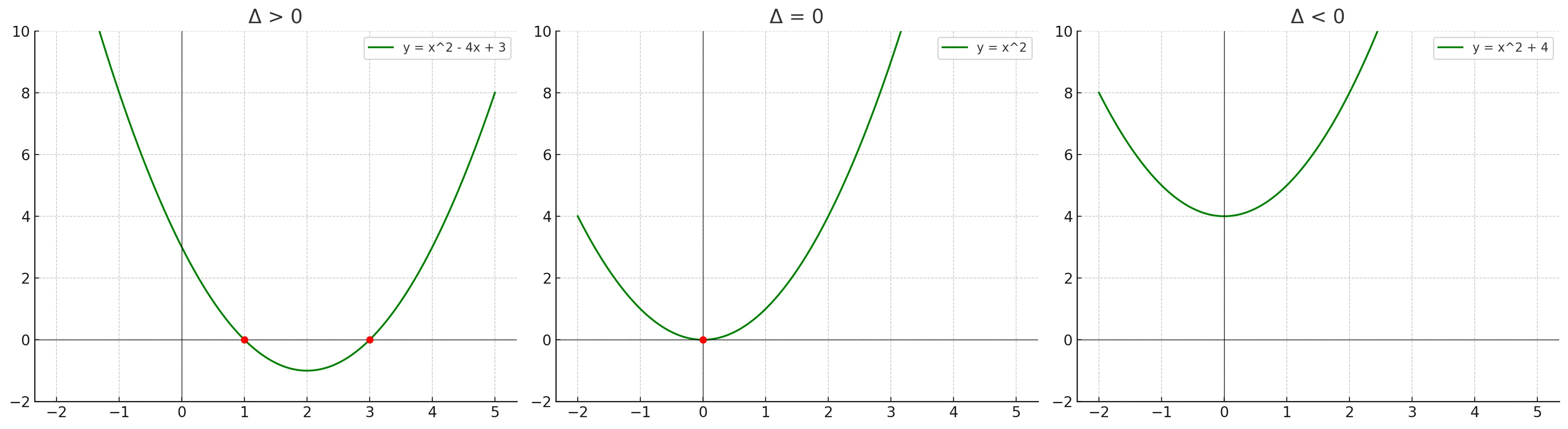
The picture supports the sign table; the factorization or completed square gives the algebraic justification. Endpoints belong to a solution only if the inequality permits equality.
For rational expressions, denominator zeros are excluded even if cancellation seems possible. To solve
split the number line at and . The quotient is positive on and , negative on , and zero at . Thus the solution is . Multiplying by without first determining its sign would miss this structure.
Absolute values and the triangle inequality
For all real ,
Equality holds exactly when , including the cases where either number is zero.
Both sides are nonnegative, so comparing their squares is equivalent. Their squared difference is
It vanishes exactly when .
In distance language, a direct journey is no longer than a journey through an intermediate point:
Apply the theorem to . Equality holds exactly when lies between and , endpoints included.
For real ,
Equality holds exactly when .
Writing gives . Interchanging gives the other direction, so the absolute difference is bounded. For the equality condition, compare the squares of and ; their difference is .
The reverse inequality says that changing a real input by at most changes its absolute value by at most . This is useful for error estimates and later for distances and complex moduli.
For a finite sequence of real terms,
Repeated application of the two-term inequality, or induction on , proves this. It includes the three-term version; for , both empty sums are zero. Equality holds precisely when the nonzero terms all have the same sign: otherwise the positive and negative totals cancel partially.
Arithmetic and geometric means
For ,
with equality exactly when .
The inequality gives , and the square vanishes exactly when .
A related identity applies to all real , with no positivity assumption:
This is often the quickest way to create a bound from a difference of expressions.
For and nonnegative ,
Equality holds exactly when all are equal.
Proof by doubling and then descending
First suppose all terms are positive. The two-term result is already known. If AM-GM holds for terms, split terms into equal-sized groups with arithmetic means . Each group’s product is at most the th power of its mean, and . Multiplying proves the result for terms. Starting at one term gives every power-of-two case.
Next suppose the result holds for terms. Given positive terms with mean , append the extra term . The new mean is still , so
Cancel positive to obtain the -term result. For any desired , start with a power of two at least and descend finitely many times. Equality in the doubling argument requires equal entries within each group and equal group means; descending retains exactly the all-equal case.
Finally, if some terms are zero, the product is zero. Equality then holds only if the arithmetic mean is also zero, which for nonnegative terms means all terms are zero.
The harmonic-to-quadratic mean chain
For positive , define
Then
The middle inequality is AM-GM. Applying AM-GM to the reciprocals and then taking reciprocals gives . For the last inequality,
Taking nonnegative square roots proves . Equality in any of the three comparisons holds exactly when all inputs are equal. Strict positivity is needed for the harmonic mean; the other three means still make sense for nonnegative inputs.
For two equal-distance trips at positive speeds , average speed is total distance divided by total time, giving
At and km/h, this is km/h. Equal times instead give the arithmetic mean, km/h. The averaging rule depends on what is held equal.
Exploration: what the mean surfaces show
For nonnegative , compare the surfaces and .
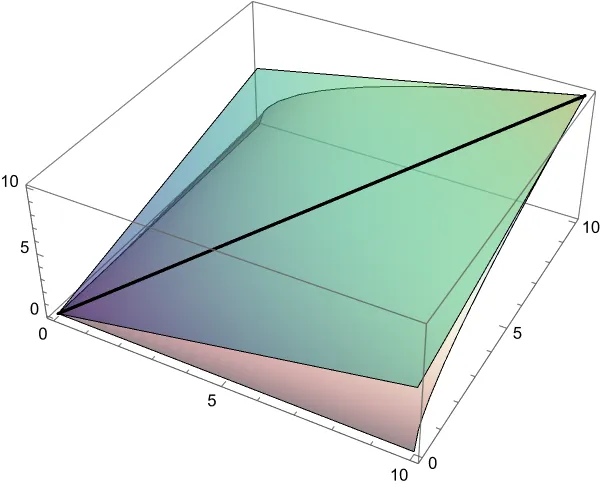
The AM-GM proof shows which surface lies above the other. Equality occurs along for . Fixing gives a vertical slice, not a horizontal one. Its two curves meet at .
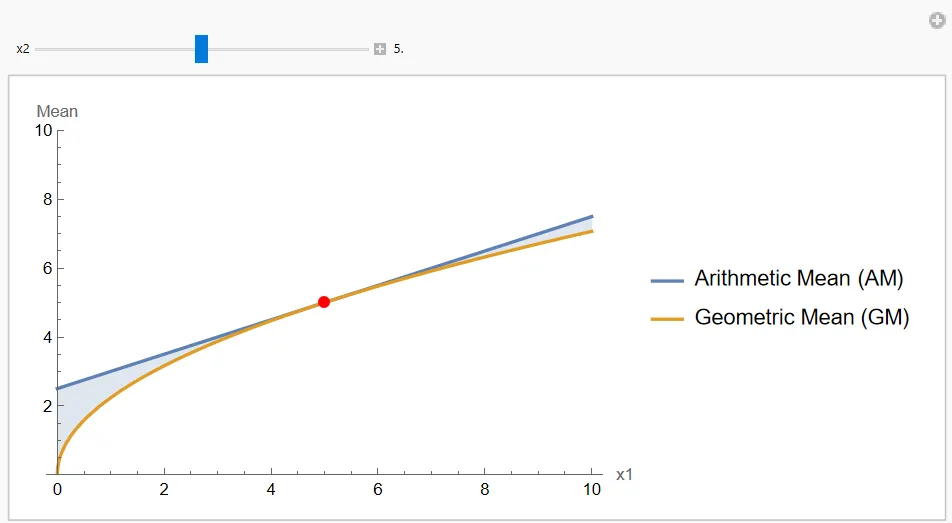
Thus changing the fixed second input from to moves the intersection to in that slice. For , the geometric mean is zero and equality occurs only at . A projected front view of a surface is not, by itself, the same construction as taking a slice.
Cauchy-Schwarz controls a sum of products
For real vectors and , write
For , . Equivalently,
Equality holds when one vector is zero, or when the two nonzero vectors are real scalar multiples of one another.
The Lagrange identity proved in Finite Sums states that
The right side is nonnegative. It vanishes exactly when every . If , choose a coordinate with ; then every . If , equality holds for every . This handles zero coordinates without dividing by all of them.
For , the difference is the single square . For , it is the sum over the three coordinate pairs. These are special cases of the same theorem, rather than separate geometric assumptions about dimensions.
An independent proof using a nonnegative quadratic
If , then and the assertion holds. Otherwise, for every real ,
Choose . The right side becomes , proving . Equality holds exactly when all vanish. Equivalently, this quadratic has nonpositive discriminant; the leading coefficient must first be known to be positive.
Inner product, length, and the correct triangle connection
The dot product is , and the Euclidean norm is . Cauchy-Schwarz becomes
In the plane or three-dimensional space, when both vectors are nonzero, their angle satisfies . The dot product is not the cosine itself. Equality in the absolute-value bound allows the same or opposite direction; if a vector is zero, the angle is undefined but the inequality still holds with equality.
To derive the Euclidean triangle inequality, expand the squared norm and bound the cross term:
Taking square roots gives , the Minkowski inequality. Equality requires one vector to be zero or the nonzero vectors to point in the same direction. Setting unused coordinates to zero now recovers the scalar triangle inequality. The expansion is essential; specializing Cauchy-Schwarz alone does not produce it.
A useful form for positive denominators
For real and positive ,
Apply Cauchy-Schwarz to the entries and , then divide by the positive sum of denominators. Equality holds exactly when every ratio has the same value. This form is often called Engel’s form of Cauchy-Schwarz.
For positive , putting , yields
with equality exactly when all are equal.
Rearrangement: improve a pairing by swapping
Let . Suppose and are real; positivity is not required. Let be a permutation and put
Pairing in opposite order minimizes the sum, while pairing in the same order maximizes it:
Suppose but the assigned values satisfy . Swapping these two assignments changes the sum by
Repeatedly removing adjacent inversions sorts the assigned values and reaches the same-order pairing, without decreasing the sum. Sorting in the opposite direction instead removes same-direction pairs without increasing the sum, giving the minimum.
Equality in the upper bound means there is no pair with but ; equality in the lower bound means there is no pair with and . Ties allow zero-cost swaps. If both original sequences are strictly increasing, only the same-order permutation maximizes and only the reverse-order permutation minimizes. Equality does not generally require all entries to be identical.
For denominations and quantities , the maximum total is , from the same-order pairing; the minimum is , from opposite order. Both are attained by explicit assignments.
Chebyshev’s sum inequality
For , if two real sequences are sorted in the same direction, then
For opposite directions, reverse the inequality. The identity behind both statements is
Expand the right side to verify it. Same-order pairs have nonnegative products; opposite-order pairs have nonpositive products. Equality holds exactly when at least one sequence is constant: if both are nonconstant and similarly ordered, their first and last entries already give a strictly positive term. The opposite-order argument is analogous.
This is a result about sums of ordered sequences. It is distinct from the probability inequality that bounds tail probabilities using variance. Loh’s earlier handout lists the sum inequality alongside rearrangement [2][2] P. S. Loh, “II. Inequalities,” 2003. June 18, 2003; notes on norms, rearrangement, and Chebyshev's sum inequality. https://www.math.cmu.edu/~ploh/docs/math/2-inequalities-solns.pdf.
Choose a method and check equality
| Shape of the problem | A useful first attempt |
|---|---|
| A difference of quadratic expressions | Complete squares or factor the difference |
| A product with a fixed sum | AM-GM, with nonnegative inputs |
| Absolute values or accumulated errors | Triangle or reverse triangle inequality |
| A sum of products | Cauchy-Schwarz |
| Squared numerators over positive denominators | Engel’s form |
| A pairing that can be permuted | Rearrangement |
If scaling every variable by multiplies both sides by the same factor , the inequality is homogeneous of degree . This permits normalization: for positive variables with sum , dividing every variable by gives an equivalent sum-one problem. Check that the transformation preserves the desired inequality. Equality conditions suggest where an optimum might occur, but a lower or upper bound becomes an attained minimum or maximum only after an admissible equality case is exhibited.
Exercises
For real variables, assess the implications , , , , and for positive integers .
Show solution
The first two conclusions require for the displayed direction; reverses it, and division by zero is forbidden. In the second implication, makes the premise impossible. The reciprocal implication holds when have the same nonzero sign, but fails across zero. The fourth implication already forces , so dividing by positive proves it. Odd powers preserve order on all reals; even powers require restricting to a range on which the power function has the appropriate monotonicity, such as for the stated direction.
Let , , and . Prove
Show solution
Both denominators are positive, and their difference is . Taking reciprocals gives . Multiplying by negative reverses the direction. The larger positive denominator makes the negative quotient closer to zero, hence larger.
Solve and . How does the first answer change if becomes ?
Show solution
The first expression is , so the strict inequality has no real solution. With , the only solution is . For the second, negate the polynomial and reverse the inequality. The resulting has positive leading coefficient and discriminant , so it is positive for all real . The original strict inequality therefore holds on all of .
Let . If and , prove .
Show solution
Regroup first, then use the triangle inequality:
The denominators in the hypotheses were chosen so the two contributions fit the total error budget.
For real , prove
Show solution
Call the right side . Bound along each of the two routes, through and through , then add the bounds to obtain . Likewise, the routes from to through and through give . Add these two inequalities and divide by two. One cannot remove a positive term from a previously obtained upper bound and assume the bound remains valid.
For , prove and determine equality.
Show solution
AM-GM gives
All quantities are positive, so the bounds may be multiplied. Equality requires equality in both applications, exactly when .
For , minimize .
Show solution
The three positive terms have product one, so AM-GM gives a lower bound of . Equality requires all three ratios equal; their product then forces each ratio to be one. Taking attains the bound, so the minimum is .
For positive with , prove and .
Show solution
Cauchy-Schwarz with the all-ones vector gives
The positive-denominator form gives the reciprocal bound directly, since the denominator sum is one. Both equalities occur at . The square-sum bound extends to real of sum one, but the reciprocal argument requires positivity.
For real and , prove
Show solution
Write
First . Squaring preserves order because both sides are nonnegative. A second application gives
Combine the bounds. If , equality is automatic. If , equality requires both Cauchy-Schwarz steps to be equalities: and must be linearly dependent, as must and , with zero vectors included in that condition.
For real , show that
for every real . When is the bound attained?
Show solution
Apply Cauchy-Schwarz to and . Alternatively, the exact gap is
If , equality occurs at . If , every value is strictly below , but approaches as grows, so the supremum is and there is no maximum. No step divides by , so the proof also covers .
For real , prove and find equality.
Show solution
Twice the difference between the two sides is
It is nonnegative, and it vanishes exactly when . This directly identifies the equality condition without an additional estimate.
Let and , and define
Prove
What does this imply for three positive numbers, including triangle side lengths?
Show solution
All are positive, with sum . The reciprocal bound gives
Consequently,
Equality holds exactly when all are equal. For , the sum is at least , hence strictly greater than . Triangle inequalities are not needed; positivity alone suffices. At , the original denominator is zero, explaining the restriction.
For positive , prove
Show solution
For the first, subtract the right side: the gap is . Equality holds at .
For the second, put , , . It becomes , whose gap is half of . Equality forces , hence .
For the third, multiply by positive and put , , . The desired statement becomes
The lists of positive values and their squares have the same ordering. Rearrangement says the identity pairing is at least as large as this cyclic pairing. Equality requires , hence .
For , prove
Use that the natural logarithm is increasing and turns products into sums.
Show solution
Taking logarithms turns the first comparison into a same-order dot product versus a cyclic pairing of with . These two lists have the same ordering, so rearrangement proves it. One may sort the paired entries simultaneously; the cyclic assignment remains a permutation after sorting.
For the second, Chebyshev’s sum inequality gives
Exponentiating preserves both comparisons. In either case equality holds exactly when . Merely taking logarithms is a reformulation, so the rearrangement or Chebyshev step is needed to finish the proof.
For positive , prove . Extend the argument to a weight with integers .
Show solution
Apply four-term AM-GM to . More generally, use copies of and copies of :
Equality holds exactly when . This proves the rational-weight case directly; extending to arbitrary real weights requires an additional limiting or convexity argument.
For , define
We proved the triangle inequality at . Test it at using and .
Show solution
Both and equal , whereas when . Thus the triangle inequality fails, and this expression is not a norm in that range. The general Minkowski inequality is valid for ; its proof beyond the Euclidean case belongs with a fuller study of norms [2][2] P. S. Loh, “II. Inequalities,” 2003. June 18, 2003; notes on norms, rearrangement, and Chebyshev's sum inequality. https://www.math.cmu.edu/~ploh/docs/math/2-inequalities-solns.pdf.
Continue with Complex Numbers, where modulus gives a two-dimensional distance and the triangle inequality reappears geometrically.
References
- [1] P. S. Loh, “6. Inequalities,” 2023. Carnegie Mellon University, Putnam Seminar, Fall 2023; classical inequalities. https://www.math.cmu.edu/~ploh/docs/math/2023-295/06-inequalities.pdf ↩
- [2] P. S. Loh, “II. Inequalities,” 2003. June 18, 2003; notes on norms, rearrangement, and Chebyshev's sum inequality. https://www.math.cmu.edu/~ploh/docs/math/2-inequalities-solns.pdf a b
Comments