Weak Law of Large Numbers
Overview
The Weak Law of Large Numbers (WLLN) is a fundamental theorem in probability theory that describes the behavior of the average of a large number of independent and identically distributed (i.i.d.) random variables.
Let be a sequence of i.i.d. random variables with finite expected value and finite variance .
Define the sample mean as:
The Weak Law of Large Numbers states that for any :
Or equivalently:
This is called convergence in probability.
For a nonnegative random variable and , . Indeed pointwise; taking expectations proves the bound. Apply it to and to obtain
The theorem concerns an infinite sequence and its first terms. Finite variance is the assumption of this proof; pairwise independence with a common mean and variance is already enough for the variance calculation.
Step 1: Compute the Expected Value of the Sample Mean
Step 2: Compute the Variance of the Sample Mean
Since the are independent:
Step 3: Apply Chebyshev's Inequality
For any :
Step 4: Take the limit
Since probabilities are non-negative, the limit must be exactly 0.
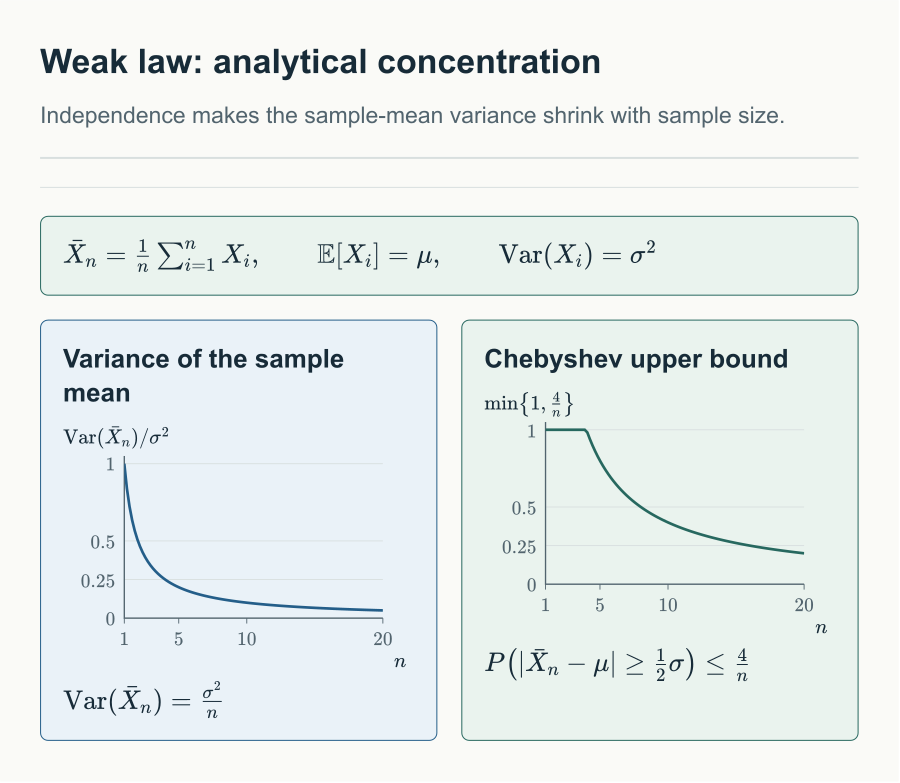
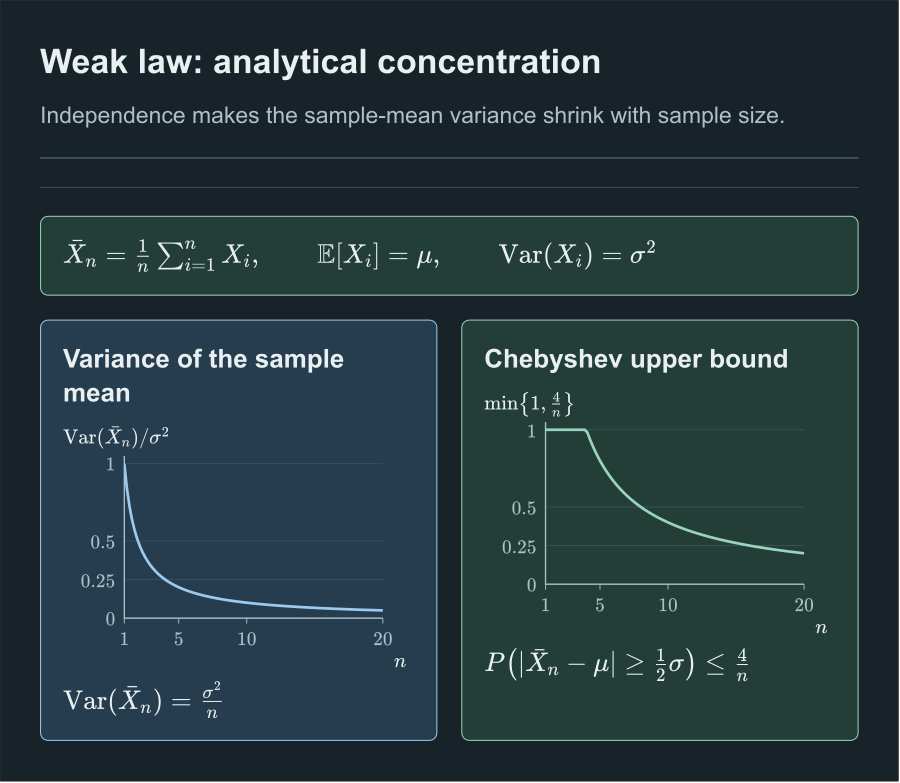
The curves show the analytical variance and Chebyshev bound, not simulated sample paths.
Interpretation
The WLLN tells us that as the sample size increases, the sample mean converges in probability to the true mean . This means that for large , the sample mean will be close to the population mean with high probability.
Applications
- Statistics: Justifies using sample averages to estimate population parameters
- Gambling: Explains why casinos have consistent profits
- Insurance: Forms the basis for risk pooling and premium calculation
- Quality Control: Validates using sample means to monitor processes
Relationship to Strong Law
The Strong Law of Large Numbers (SLLN) states almost sure convergence:
Almost-sure convergence implies convergence in probability. For fixed , let . These events decrease with . Almost-sure convergence makes their intersection a null event, so continuity of probability from above gives . For , .
The converse fails for general sequences. On with uniform probability, list the indicators of the dyadic half-open intervals of length , level by level for . Each indicator has probability of being one, so the sequence converges in probability to zero. Every point lies in one interval at every level and outside another, so its indicators take both values infinitely often and do not converge pointwise. This distinguishes convergence notions; it does not deny that the i.i.d. finite-variance sample means in this chapter also satisfy a strong law. A proof of that stronger theorem belongs to the planned probability-limit chapter.
For a fair coin with , let if the -th flip is heads, otherwise.
The proportion of heads in flips is . By WLLN:
This means that as we flip the coin more times, the proportion of heads will approach 0.5.
For more details on expectation and variance, see Expectation and Variance.
Comments