The statement “if an integer is divisible by , then it is even” is true. Reversing it produces a false statement. Reversing it and negating both parts, however, preserves its truth. Understanding why these operations differ is more useful than memorizing their names: it tells us which proof tasks we may substitute for the original one.
We work in classical logic, with the domain and interpretation fixed as in Propositions and Axiomatic Systems. Here denotes logical equivalence: two formulas agree under every truth assignment, not merely in one example. For a review of the truth conditions of implication and biconditional, see MIT’s introductory proof notes [1][1] T. Leighton and R. Rubinfeld, “What Is a Proof?,” 2006. MIT 6.042/18.062J lecture notes, September 7, 2006. https://web.mit.edu/neboat/Public/6.042/proofs.pdf.
Four forms of a conditional
Let be the hypothesis and the conclusion of . A conditional fails exactly when its hypothesis is true and its conclusion false. The other three combinations satisfy it, including cases where the hypothesis is false.
| Name | Form | Operation |
|---|---|---|
| Original | None | |
| Converse | Swap the two parts | |
| Inverse | Negate both parts | |
| Contrapositive | Swap and negate both |
The domain stays fixed throughout these transformations. In an assertion about every integer , each form is still an assertion about every integer . Changing the domain or dropping a hypothesis changes the problem in addition to changing its logical form.
Let mean that divides , and let mean that is even. Each claim below is universally quantified over .
- Original: if divides , then is even. This is true, since for some integer .
- Converse: if is even, then divides . This is false at .
- Inverse: if does not divide , then is not even. This is also false at .
- Contrapositive: if is not even, then does not divide . This is true: a multiple of would be even.
The counterexample to the converse also refutes the inverse. In both cases, it makes that form’s hypothesis true and conclusion false.
Why the equivalences hold
The original and contrapositive form one equivalent pair; the converse and inverse form another. A truth table checks every assignment rather than relying on a chosen arithmetic example.
| T | T | T | T |
| T | F | F | F |
| F | T | T | T |
| F | F | T | T |
The last two columns match in every row. Another way to see this is to ask when the contrapositive fails: must be true and false, which again means is true and false. Thus,
Apply the same result to . Its contrapositive is , so
The two pairs are not generally equivalent to one another. At , the original is false but the converse true. They can agree in particular situations, so “not generally equivalent” does not mean “always opposite.”
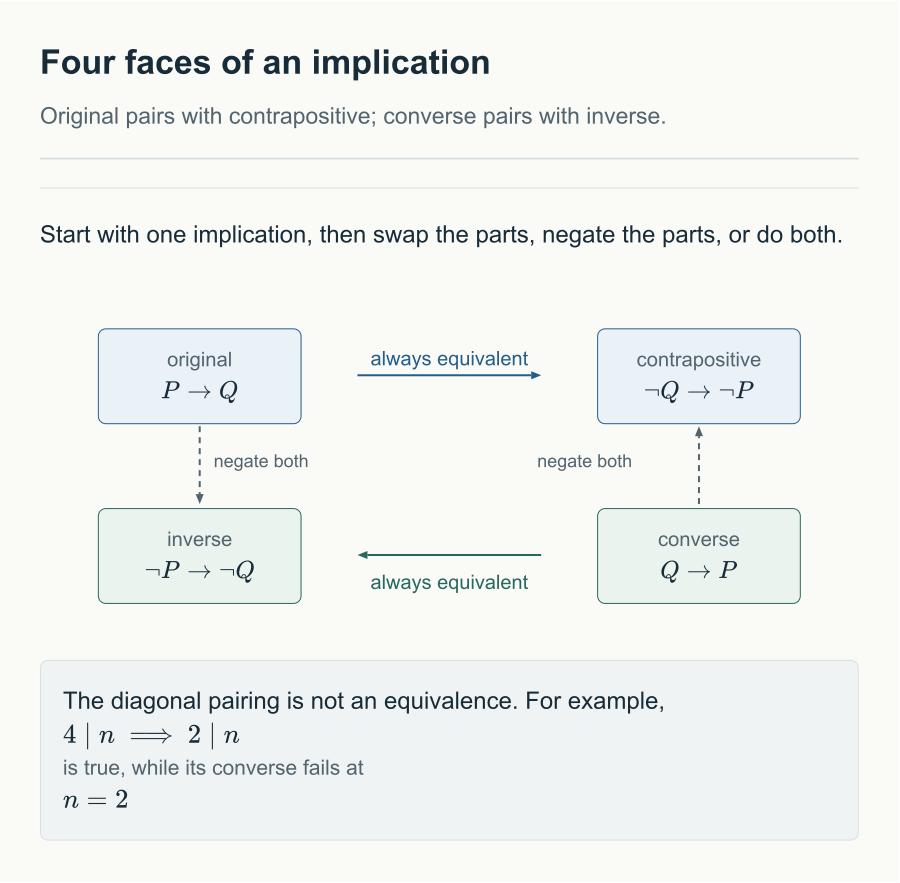
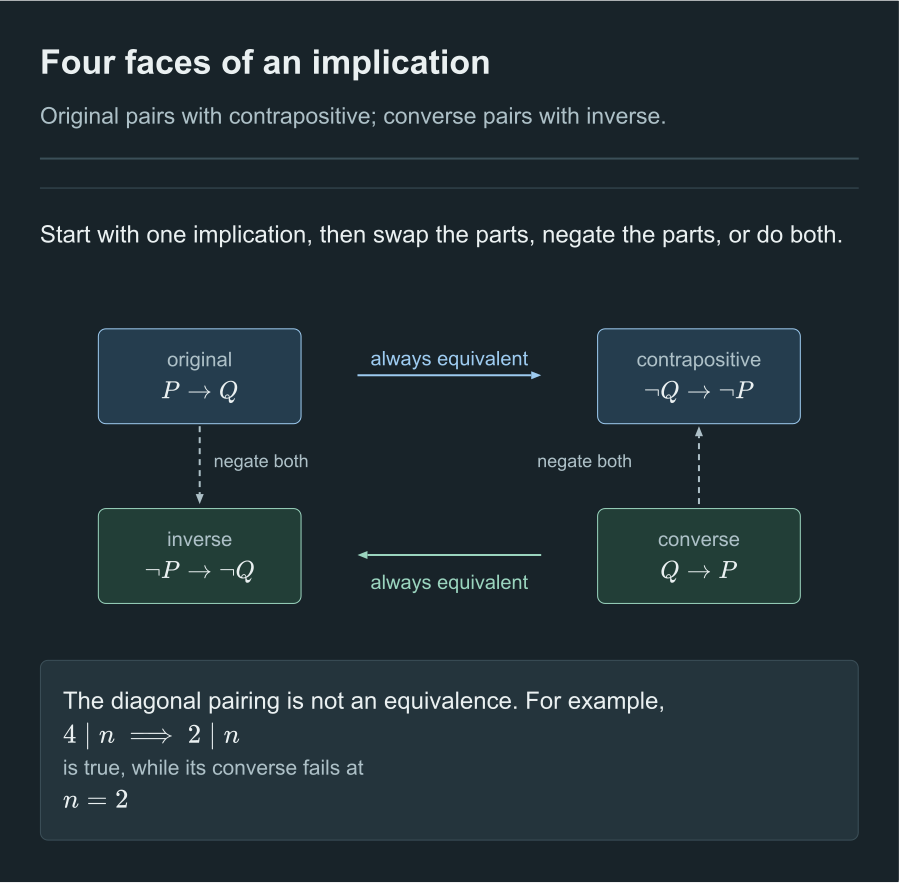
These transformations describe logical relationships. The diagram helps locate the pairs, while the truth table establishes the equivalence.
The inverse is not the negation
The inverse negates the two components and retains an implication. Negating the entire implication instead asks for exactly the situation it excludes:
For example, the negation of “if divides , then is even” says that divides and is not even. It does not say “if does not divide , then is not even.” The latter is the inverse.
For a universal claim, the negation also changes the quantifier:
This is why one counterexample can refute a universal implication: the witness must satisfy its hypothesis and violate its conclusion. By contrast, forming the contrapositive preserves the universal quantifier and the domain.
The negation of is , not . If the condition is compound, use De Morgan’s laws:
For instance, the contrapositive of “if and , then ,” for real , is “if , then or .” Negating each inequality while leaving “and” unchanged would be incorrect.
Sufficient, necessary, and equivalent conditions
Saying that is sufficient for means that guarantees . Saying that is necessary for means that cannot hold without . Both express ; they describe the same direction from different ends.
| Wording | Logical form |
|---|---|
| is sufficient for | |
| is necessary for | |
| only if | |
| if | |
| if and only if |
Being divisible by is sufficient for being even. Being even is necessary for being divisible by , but is not sufficient: still supplies a counterexample. To prove an “if and only if” claim, establish both the original and its converse. Proving the original and its contrapositive establishes the same direction twice.
A set interpretation makes this concrete. Inside a fixed domain , let contain the objects satisfying and those satisfying . The universal implication says . Its contrapositive says
Both inclusions exclude an object in but outside . The converse requires , an additional condition; both directions together give .
A complete proof by contrapositive
For every integer , if is even, then is even.
The hypothesis describes a square, while the conclusion describes its root. Starting from an odd integer gives an explicit expression we can square, so the contrapositive offers a useful starting point. We use the integer parity fact that every integer is exactly one of even or odd; this follows from division by with remainder or .
Fix an arbitrary integer . We prove that if is not even, then is not even. By the parity fact, write for an integer . Then
Since is an integer, is odd and therefore not even. This proves the contrapositive, hence the original implication. As was arbitrary, the result holds for every integer.
The domain matters. For real numbers, “not even” cannot simply be replaced by “odd”; the parity dichotomy used here is a fact about integers. Also, showing that an even has an even square would prove the converse, which does not by itself establish the stated proposition.
Contrapositive and contradiction proofs
A proof by contrapositive starts from and establishes . A proof by contradiction of instead assumes the negation of that implication, namely , and derives a contradiction. For a universally quantified theorem, a contradiction proof begins by assuming there is a counterexample and taking such a witness.
These descriptions are related, and a proof of a contrapositive can itself use contradiction. In the parity proof above, however, we directly computed an odd square from an odd integer. No assumption that is even was needed. Choose the approach that exposes usable definitions or structure, and state what is assumed and what remains to be shown. See Indirect Proof for further examples.
Exercises
For real , consider “if , then .” Write its converse, inverse, and contrapositive. Determine whether each universal claim is true, giving counterexamples when appropriate.
Show solution
The original is true. The converse is “if , then ”; it fails at . The inverse is “if , then ”; the same value refutes it. The contrapositive is “if , then ,” which is true and equivalent to the original. Using in place of would omit the boundary point when negating the condition.
Negate “for all integers , if is even, then and are both even.” Supply a witness to the negation.
Show solution
The negation says that there exist integers such that is even and at least one of is not even. Take : the product is , but is odd. The negation of “both even” is “at least one not even,” not “both odd.”
A student proves and , then concludes . Explain the gap. What additional direction would suffice?
Show solution
The two proved forms are equivalent, so both establish only the original direction. The missing direction is , or equivalently . The assignment satisfies both proved forms but makes the biconditional false.
Prove that for every integer , if is odd, then is odd. State the contrapositive before beginning the calculation.
Show solution
The contrapositive says that if is even, then is even. Write with . Then
Since is an integer, this expression is even. The contrapositive, and hence the original claim, follows.
What to read next
Before changing a proof task, identify its domain, hypothesis, conclusion, and quantifiers. Then check whether you have taken the converse, the contrapositive, or the negation of the entire statement. Continue with Direct Proof to practice turning definitions into a justified chain of deductions.
References
- [1] T. Leighton and R. Rubinfeld, “What Is a Proof?,” 2006. MIT 6.042/18.062J lecture notes, September 7, 2006. https://web.mit.edu/neboat/Public/6.042/proofs.pdf ↩
Comments