This article grew out of exploratory notes from my parallel computing study. It is a speculative learning note, not a formal semantics of C. I use C pointers as a small entry point, then sketch how memory-address ideas can be described with simple mathematical language: functions, composition, address spaces, hierarchy, and distributed mappings.
Introduction
Let's examine a classic C programming question:
int AValue = 101;int *BValue = &AValue;// Why does *BValue return 101?On the surface, this seems simple. The useful question is what kind of mapping is hiding underneath it. While we start with C pointers as the example, the same style of thinking appears again in virtual memory, cache hierarchy, distributed storage, and other memory-like systems.
The mathematical language below should be read as modelling intuition. Some equations are deliberately simplified so that the structural idea is visible before the real-world edge cases are added back.
Mathematical Memory Model
Let's model computer memory as a mathematical function. Define:
Where:
- represents the value stored at memory address
- Each variable has a unique memory address
- represents the set of natural numbers (memory addresses)
- represents the set of integers (possible values)
This function-based model is only a first approximation, but it gives us a useful way to talk about pointers before moving to a more abstract memory mapping framework.
Variable and Pointer Definitions
Memory Address Assignment
Define:
- Let be the memory address of variable
AValue - Let be the memory address of variable
BValue
Reference and Dereference Operators
The reference operator and dereference operator can be defined mathematically:
These definitions capture the essence of pointer operations in mathematical terms.
Step-by-Step Mathematical Analysis
Let's trace through our C code example using this mathematical framework.
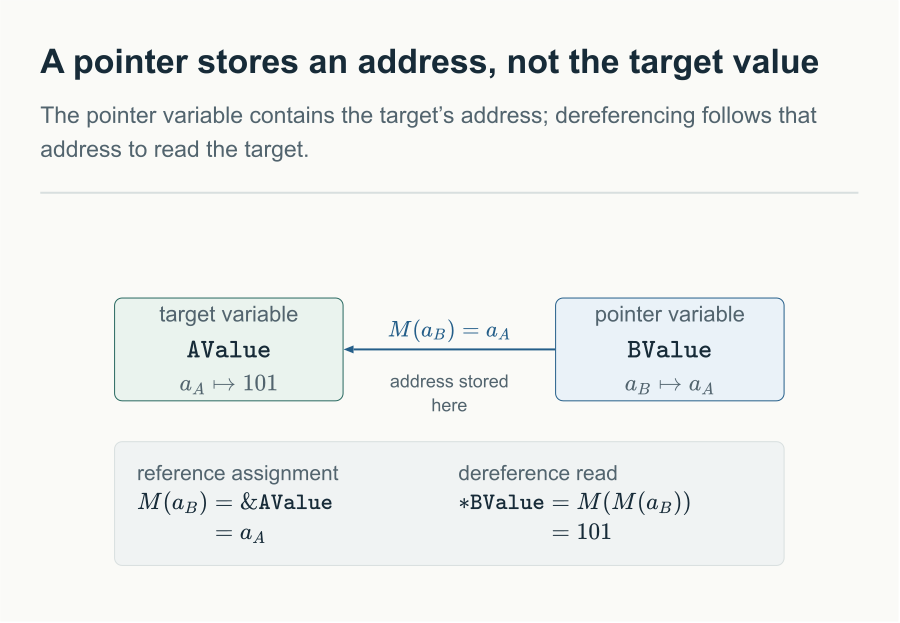
The pointer contains the target address; dereferencing performs a second memory lookup to obtain the value.
Step 1: Initial Assignment
int AValue = 101;This operation modifies our memory function:
Step 2: Pointer Assignment
int *BValue = &AValue;This sets the value at to the address of AValue:
Step 3: Dereferencing Operation
Now, when we evaluate *BValue:
Substituting from Step 2:
Substituting from Step 1:
Function Composition Analysis
The reference and dereference operators suggest a useful mathematical relationship.
Function Definitions
Define the reference function: where
Define the dereference function: where
Mapping Properties
-
Forward Mapping (Reference):
- Maps variable values to their memory addresses
- (address of variable x)
-
Inverse Mapping (Dereference):
- Maps memory addresses to their stored values
- (value at address p)
Limited Inverse-Style Intuition
On a named, allocated variable in this toy model, dereferencing the address of a variable recovers the stored value:
The converse direction is more fragile:
This second equation is not a general law of C. It only makes sense in an oversimplified model where every value can be treated as a uniquely addressable variable. In real programs, two locations can store the same value, temporary values may have no stable address, and invalid pointers can make dereference undefined. I keep the notation because it gives a useful first intuition, but it should not be read as a full proof.
Bijective Relationship
For reference and dereference to behave like true inverses in a model, the model would need restrictive assumptions:
-
Injective (One-to-one):
- If , then , so
- If , then , so
-
Surjective (Onto):
- For every address , there exists a variable such that
- For every value , there exists an address such that
Composition Identity
Under those restrictions, the toy model suggests:
The inverse relationship can then be expressed as:
Therefore:
Category-Theory Vocabulary as a Sketch
A possible memory category
If we wanted a more formal model, one possible starting point would be to describe memory systems with category-theory1A branch of mathematics that deals with abstract structures and relationships between them. vocabulary:
- Objects: Memory spaces where is the address space, is the value space, and is the memory mapping
- Morphisms: Memory-preserving functions between memory spaces
- Composition: Function composition of memory mappings
This is only a sketch. The hard part is deciding which structure the morphisms must preserve: raw addresses, allocation regions, permissions, page identity, temporal state, or some combination of them.
A possible memory functor sketch
After those categories are defined, a toy construction could look like a functor where:
- is the category of sets and functions
- is a chosen category of memory spaces and structure-preserving morphisms
- maps a set to the memory space
The point is not that this is the right semantics of memory. It is a compact way to ask what kind of structure is being preserved when we move from one memory representation to another.
A cautious categorical analogy
It is tempting to describe reference and dereference with category-theory language, but that needs care. In this note, and are ordinary maps inside a toy memory model. They are not automatically functors, and the note does not prove an adjunction.
The safer analogy is simpler:
- records how a named value is associated with an address.
- records how an address is read back into a value.
- describes the useful "take the address, then load from it" pattern under restrictive assumptions.
Category theory becomes relevant only after we define precise categories of memory states and structure-preserving maps between them. I leave that as an intuition, not as a theorem.
Topology of Memory Spaces
Memory as a Topological Space
We can endow the address space with a topology2The study of properties of space that are preserved under continuous deformations. that reflects the structure of memory:
- Open Sets: Represent accessible memory regions
- Closed Sets: Represent protected or reserved memory regions
- Continuity: Memory operations that preserve accessibility
Metric Properties
Define a metric on the address space:
This metric induces the standard topology on , where:
- Balls: represent memory neighborhoods
- Continuity: For raw stored values this is usually not a realistic assumption; it is more useful as an analogy for preserving accessibility or layout relationships
Compactness and Memory Allocation
- Compact Sets: Finite memory regions that can be completely allocated
- Connected Components: Contiguous memory blocks
- Separation Properties: Memory protection and isolation
Homeomorphisms and Memory Remapping
A memory remapping is a homeomorphism if:
- is bijective
- Both and are continuous
- preserves memory accessibility relationships
This is only a rough analogy for address remapping. Real virtual memory translation is permissioned, partial, page-based, and not usually a homeomorphism in the strict topological sense.
Algebraic Structures in Memory
Offset arithmetic, not a global address algebra
It would be too strong to say that real program addresses form an abelian group or a ring. C pointer arithmetic is typed, bounded by allocated objects, and can become undefined outside those bounds. The null pointer is also not a neutral element for ordinary address addition.
A safer model is local offset arithmetic. Within one allocated array-like region, an address can be represented as:
This local model inherits some familiar arithmetic laws, but only inside the valid region and only for the relevant element type. It is a tool for reasoning about layout, not a global algebra of all memory addresses.
Homomorphisms Between Memory Models
A memory homomorphism preserves the algebraic structure:
This can model memory abstraction layers only when the chosen maps actually preserve the structure we care about, such as offsets, permissions, or page identity.
Algebraic Proof
Given the assignment , we can prove:
This toy calculation shows why the simple pointer example behaves as expected.
Memory Mapping Visualization
The memory mapping can be represented as:
Therefore:
This double dereference pattern is fundamental to understanding pointer behavior. The first gets the address stored in the pointer, and the second gets the value at that address.
Practical Implications
Pointer Aliasing
When two pointers point to the same memory location, we have:
This means:
Pointer Arithmetic
Pointer arithmetic can be modeled as:
Where is the size of the pointed-to type in bytes.
Null Pointers
A null pointer can be represented as:
With the special property:
Common Pointer Patterns
Function Pointers
Function pointers extend our model:
Double Pointers
Double pointers (pointers to pointers) create nested mappings:
Memory Safety Considerations
Our mathematical model helps explain common pointer errors:
Dangling Pointers
Buffer Overflows
When exceeds allocated memory bounds:
General Memory Mapping Theory
Abstract Memory Mapping Framework
Let's generalize beyond our initial simple model. A Memory Mapping System is a tuple where:
- : Address space (possibly structured)
- : Value space (possibly structured)
- : Memory mapping function
- : Set of memory operations
Classification of Memory Mappings
By Injectivity
- Injective: (no aliasing)
- Non-injective: Allows multiple addresses to map to same value
By Surjectivity
- Surjective: (full coverage)
- Non-surjective: Some values cannot be stored
By Composition Properties
- Idempotent:
- Involutive:
- Nilpotent:
Memory Mapping Composition
Given two memory systems and , we can define:
Direct Sum
Tensor Product
Function Composition
If , then:
Memory Mapping Decomposition
A memory mapping can be decomposed as:
Where:
- is the inclusion map
- is the projection map
This decomposition is mostly a reminder that a memory read can be factored through a richer paired representation. I would not treat it as a universal property unless the surrounding category and morphisms are defined explicitly.
Optional universal-property sketch
In a more formal development, one might ask whether there is a "free" memory-like construction generated by an address set . Such a construction would have to satisfy a universal property of the form:
where embeds addresses into the generated structure. This note does not build that category; it only records the shape of the question.
Memory mapping categories
If such a category Mem is defined, it could contain:
- Objects: Memory mapping systems
- Morphisms: Memory-preserving functions
- Composition: Function composition
Only after that definition could we ask whether it has:
- Products: Direct products of memory systems
- Coproducts: Disjoint unions of memory systems
- Exponential Objects: Function spaces between memory systems
Multi-level Memory Hierarchy
Hierarchical Memory Systems
A Memory Hierarchy is a sequence where:
- : Level 1 (fastest, smallest)
- : Level n (slowest, largest)
- Transfer functions for
Performance Metrics
Define the Access Time Function :
The Effective Access Time for memory access pattern :
Where is the hit rate at level for pattern .
Cache Memory Mathematics
For a cache with associativity , the Cache Hit Probability is:
Where is the probability of accessing within positions.
Optimal Replacement Strategies
The Optimal Replacement Problem can be formulated as:
Where is the replacement strategy and is the miss indicator.
Virtual Memory Theory
Address Translation Functions
Virtual memory systems use address translation:
Where is typically piecewise defined based on page tables.
Page Table Mathematics
A page table can be represented as a function:
Where:
- VPN: Virtual Page Number
- PPN: Physical Page Number
- Permissions: Access rights bitmap
Translation Lookaside Buffer (TLB)
The TLB is a cache for address translations:
With TLB Hit Rate:
Memory Fragmentation
External Fragmentation
The External Fragmentation Ratio:
Internal Fragmentation
The Internal Fragmentation Ratio:
Concurrent Memory Access Models
Shared Memory Systems
For concurrent access, we extend our model to:
Where is the set of time points or thread identifiers.
Consistency Models
Sequential Consistency
Linearizability
Each operation appears to occur atomically at some point between its invocation and completion.
Memory Fences and Synchronization
Define Memory Orderings as relations on memory operations:
- Sequential Consistent: Total order on all operations
- Release-Acquire: Synchronizes operations via release/acquire pairs
- Relaxed: No ordering guarantees beyond program order
Race Condition Analysis
A Data Race occurs when:
Where denotes concurrent execution without synchronization.
Applications Across Domains
Database Memory Management
Database systems use memory mapping to implement:
- Buffer Pools:
- Index Structures: -trees as hierarchical memory mappings
- Query Processing: Intermediate result mappings
The mathematical model for database buffer pools can be represented as:
Where each memory frame has a state indicating whether it needs to be written back to disk.
Replacement strategies can be modeled as:
The optimal replacement strategy minimizes page faults:
Distributed Computing
Distributed memory systems involve:
- Partitioning:
- Replication: Multiple mappings for same data
- Consistency: Distributed memory consistency protocols
The address mapping in distributed systems can be represented as:
Consistency models define synchronization rules between multiple replicas:
- Strong consistency: All replicas are identical at all times
- Eventual consistency: Replicas converge to the same state over time
- Causal consistency: Causally related operations are executed in order
The mathematical model for data replication:
Where each node stores a copy of the data.
Conclusion
The pointer dereference evaluates to 101 because BValue stores the address of AValue, and dereferencing follows that address back to the stored integer. In the toy notation, this is the useful part of the model:
That identity is a teaching shorthand, not a complete account of C memory. The value of the notation is that it trains the same mental habit needed for larger systems: name the address space, name the value space, and ask what mapping connects them.
This is why I still keep the article. It is not a finished theory, but it points toward a useful bridge between low-level programming and mathematical modelling: from C pointers to virtual memory, cache behaviour, concurrent memory, and distributed address spaces.
Comments